By the mid-1880s, Gerard Heineken had already built something remarkable in Amsterdam and Rotterdam. But he wasn't satisfied with Europe. He wanted to know how far his beer could actually travel — and he kept a journal to track it.
That journal survives today, and it tells a quietly astonishing story. The earliest surviving pages begin in 1883, with shipments to Panama. Within a year, Heineken beer was reaching Havana, Jamaica, Rio Grande do Sul, Berbice, Santos, Rio de Janeiro, Caracas, Buenos Aires and Valparaíso — a brewery barely twenty years old, already chasing ports on the other side of the planet. The breakthrough that made this possible had come a decade earlier, in 1874, when Gerard tested whether his beer could survive pasteurization at the Rotterdam brewery. It could. That single experiment turned a local Amsterdam beer into something that could survive months at sea.
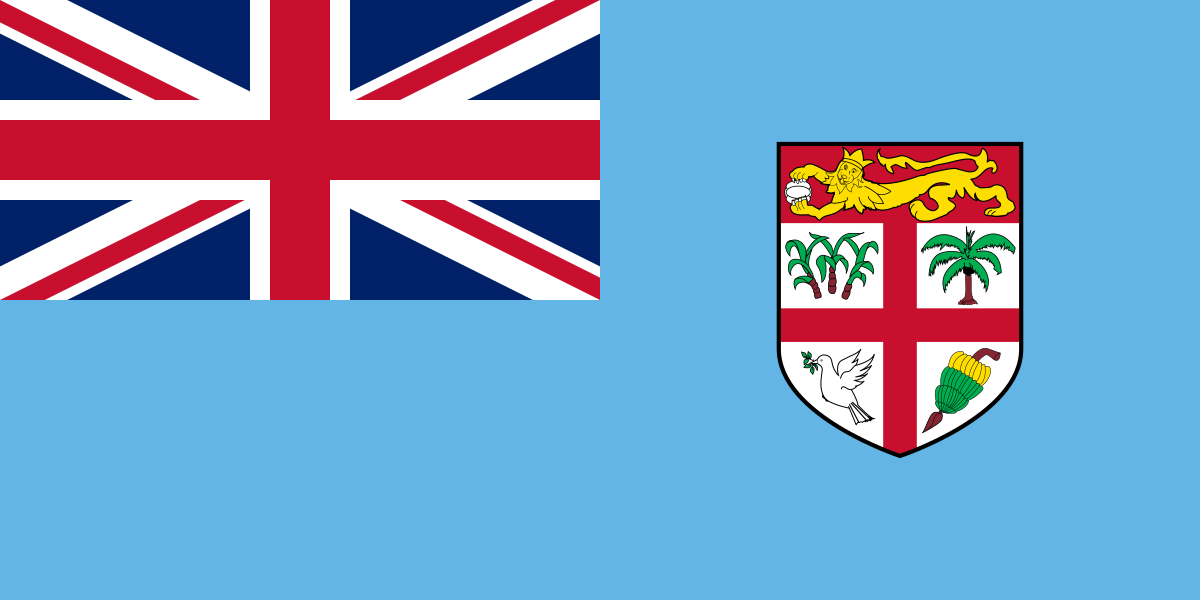
By 1885, that same export network had reached somewhere far more unlikely: the Fiji Islands, on the absolute opposite side of the world from Amsterdam. Specifically, it reached the Royal Hotel in Levuka — at the time the capital of the British Crown Colony of Fiji, and reputedly the oldest hotel in the entire Pacific. Gerard's own journal records the shipment precisely: forty cases of whole bottles and ten cases of half bottles, delivered that year for roughly £85.
It's worth sitting with how remarkable that actually is. Fiji in 1885 was about as far from Amsterdam as it was possible to get — a small British colonial outpost, reachable only by a long sea voyage, almost certainly the same kind of route that also carried Heineken's beer to Ceylon, Burma, and the Chinese treaty ports of Tientsin, Shanghai and Hong Kong around that same period. Gerard wasn't simply hoping his beer might survive the journey. He was tracking it, port by port, in his own handwriting, building a genuine picture of how far his name could travel.
We don't know exactly who ordered that shipment, or how a hotelier in a small Pacific colony first heard of a Dutch brewery that, at the time, was barely two decades old. What we do know is that for a brief window in the 1880s, a visitor stepping into the Royal Hotel bar in Levuka — sailors, traders, colonial administrators, the kind of people who passed through the Pacific's port towns — could order a Heineken, brewed and bottled half a world away, and carried there one shipment at a time by a young Amsterdam brewer determined to find out exactly how far his beer could go.
Gerard's own export journal ends abruptly in March 1893 — the same month, and with the same abruptness, as his sudden death at just 51 years old. What happened to Heineken's presence in Fiji in the decades that followed isn't yet documented in this archive. But the beer found its way back. Today, more than a century later, Heineken Lager is once again available in Fiji — sold now from supermarkets and resort bars in Suva rather than a single hotel in Levuka, but tracing, in a real and direct line, back to those forty cases that arrived at the Royal Hotel in 1885.