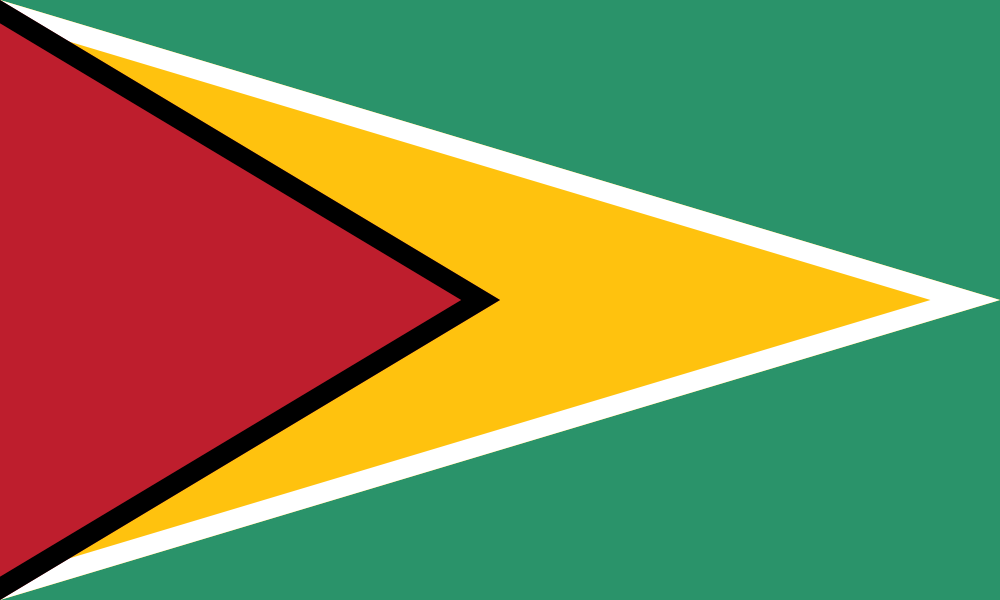
Guyana's connection to Heineken does not begin with a beer run. It begins with a Dutch family, a colony on the Berbice River, and a debt that history has never fully settled.
In 1829, Gerard Adriaan Heineken's mother Anna married into the Schumacher family, whose plantation holdings stretched across Berbice — a Dutch colony on the northeastern coast of South America, the very territory that would one day become Guyana. The Schumachers owned several estates along the Berbice River, worked by enslaved people under conditions that were, by any account, brutal. When Anna's first husband Pieter Schumacher died in 1833, she inherited a share of that wealth. Four years later she married Cornelis Heineken, and in 1864 her son Gerard bought De Hooiberg brewery in Amsterdam. Whether plantation money helped fund that purchase remains historically unresolved — but the records at Kew and the Amsterdam Archief confirm the financial link between the Schumacher estates in Berbice and the family that built the world's most international brewery.
Twenty years after founding his brewery, Gerard sent 30 cases of beer to Berbice. The year was 1884. It was a single documented shipment — recorded in his own export journal, the same one that tracks early deliveries to Colombo, Shanghai, and Cape Town. Whether those cases were ordered by a Dutch colonial merchant, a planter, or a hotel keeper, we do not know. What we know is that Gerard shipped beer to the land his mother's first family had owned. Make of that what you will.
Then came 124 years of silence.
Guyana gained independence from Britain in 1966, became a republic in 1970, and spent the following decades as one of the poorest countries in the Western Hemisphere — not the obvious first stop for a premium European lager. The local market belonged to Banks Beer, brewed since 1955 at the Thirst Park brewery in Georgetown, and Guinness, which Banks DIH bottled under licence from Diageo. When Heineken arrived in 2008, Banks DIH publicly stated they had no association with the brand and no involvement in the launch. The import was handled by Caribbean International Distributors Incorporated — CIDI — a Surinamese-backed company based in McDoom, on the East Bank Demerara.
There was a neat logic to the supply chain. CIDI did not ship Heineken from the Netherlands. They imported it from Windward and Leeward Brewery in Vieux Fort, Saint Lucia — Heineken's own Caribbean brewery, established in 1975 and serving the region for decades before it was formally renamed Heineken Saint Lucia Ltd. in 2021. The beer arriving at Georgetown's docks was Caribbean-brewed, Caribbean-shipped Heineken, moving through a CARICOM supply chain that would later become the subject of a landmark Caribbean Court of Justice ruling, when Guyana's environmental tax on non-returnable beverage containers was found to violate regional trade law. CIDI won that case in 2014 and was reimbursed over six million US dollars.
Today Heineken Lager is on the shelves at Massy Stores in Georgetown. No brewery, no joint venture, no local brand. Just the green bottle, working its way through a trade corridor that connects the Caribbean to the South American mainland — and, if you trace it far enough back, to a plantation on the Berbice River that a Dutch family once owned.