Beer arrived in Namibia before the roads did. In the late 1800s, when the territory was still German South West Africa, beer was imported directly from Germany — high-alcohol lagers designed to survive the long sea voyage, and almost universally found too strong for the heat of the African interior. The solution was obvious: brew locally.
By 1920, the territory had several small breweries, all of them struggling. The founders of what would become the Ohlthaver & List Group saw an opportunity and acquired four of them — Klein Windhoek Brauerei, Felsenkeller Brauerei, Omaruru Brauerei and Kronen Brauerei in Swakopmund — merging them under the name South West Breweries Limited. The consolidation worked. Through two world wars, the transition from German to South African administration, and the political upheaval of the apartheid era, the brewery kept producing across three sites — Windhoek, Swakopmund and Tsumeb. One rule held constant throughout: strict adherence to the German Reinheitsgebot purity law of 1516, using only malted barley, hops and water. In a territory shaped by German colonial history, this was not just a brewing standard. It was an identity.
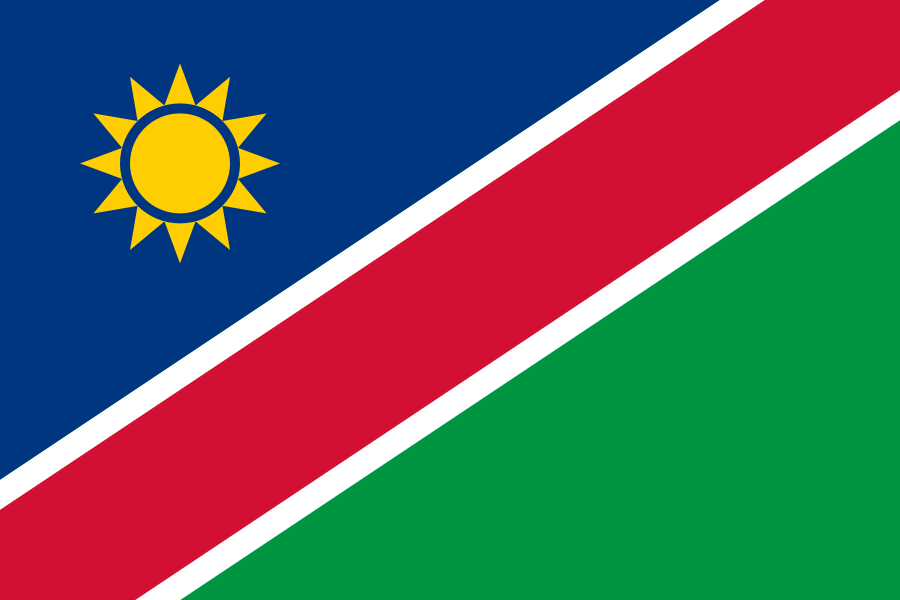
When Namibia gained independence on 21 March 1990, South West Breweries became Namibia Breweries Limited — a symbolic renaming that tied the brewery's future to the new nation's. The company listed on the Namibian Stock Exchange in 1996. By then, Windhoek Lager was no longer just a local beer — it was exporting to South Africa and beyond, carrying the Reinheitsgebot story into premium segments where most African lagers could not compete. By 2004, NBL was exporting to 22 countries and had captured thirty percent of the premium segment in South Africa — remarkable for a brewery from a country of fewer than two million people.
Heineken had been watching that trajectory. From around 1999, Heineken Export began building a closer working relationship with NBL. The fit was logical — NBL had the premium credentials, the German brewing heritage, and a distribution network that was punching well above its weight in the South African market. In May 2003, Heineken beer began rolling off the NBL production line under licence. That same year, Heineken and Diageo jointly acquired a 28.9% stake in NBL through NBL Investment Holdings — the first formal ownership stake, shared between two of the world's biggest drinks companies. Amstel, meanwhile, was still being sold in Namibia under a separate SAB/Miller licence arrangement — a reminder of how tangled the regional beer relationships could be.
The relationship deepened through shared production agreements and joint distribution under DHN Drinks. In 2015, following Diageo's exit from the beer side of the joint venture, Heineken and NBL restructured into a beer-focused partnership. The green bottle and the green cap had been circling each other for years. The acquisition was announced in November 2021, as part of Heineken's broader Southern Africa transaction alongside Distell Group Holdings — a combined deal valued at US$4.6 billion, with NBL alone valued at €400 million. The final regulatory approval came from the South African Competition Tribunal in March 2023. On 26 April 2023, Heineken completed the acquisition, integrating NBL into a new entity called HEINEKEN Beverages alongside Distell and Heineken South Africa. Heineken holds 59.37% of the combined business.
The brewery in Windhoek's Northern Industrial Area on Iscor Street still brews the same three ingredients it always has. Windhoek Lager, Tafel Lager, Windhoek Draught, Windhoek Light, Hansa Pilsener — all Reinheitsgebot, all made in the same city where the consolidation began in 1920. Heineken Lager is now also brewed there under licence. One hundred years of brewing independence, and then the red star arrived. It had been circling since 1999.