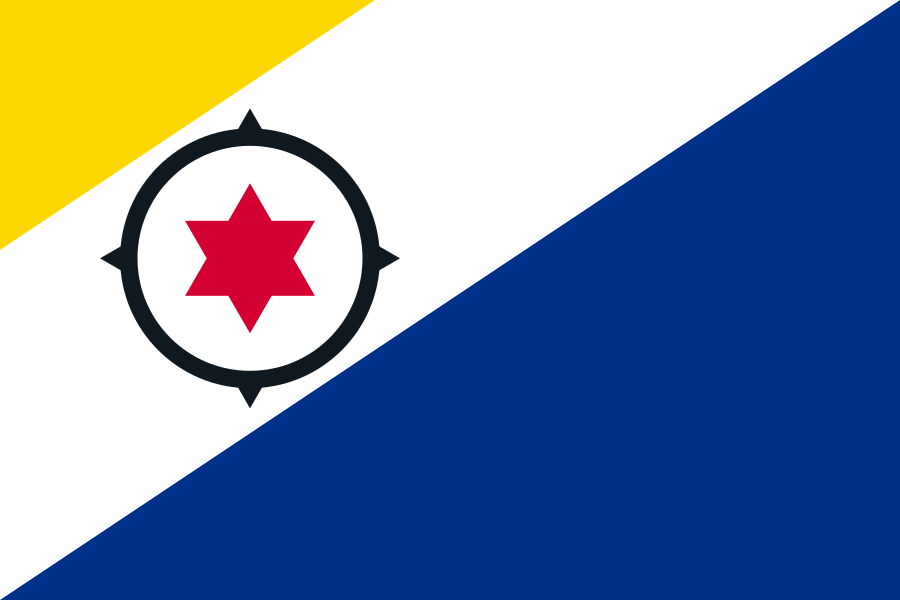
Some countries in Heineken's story come with dramatic entrances, failed rentals, boardroom feuds, or decades-long silences. Bonaire has none of that. It has something rarer: a nearly century-long, largely uninterrupted relationship.
A Steady Start
Heineken's presence on Bonaire dates back to at least 1930, when "Heinekens Lager Beer" first reached the island — a small piece of the Dutch Caribbean that has remained continuously Dutch territory ever since, first as part of the Netherlands Antilles, and since 2010 as a special municipality of the Netherlands itself, the "Caribbean Netherlands." That unbroken constitutional tie likely explains something notable about Bonaire's import record: it simply never stops. No world war interruption, no independence-era gap, no boycott, no licensing dispute — just steady, continuous supply for nearly a hundred years.
In 1954, in step with Heineken's broader global rebrand, "Heinekens Lager Beer" quietly became "Heineken Lager" — the same naming shift playing out on Bonaire's shelves as everywhere else in the portfolio.
A Portfolio That Kept Growing
What makes Bonaire's story genuinely interesting isn't drama — it's breadth. Amstel Lager joined in 1968, right as Heineken formally acquired the Amstel brewery back home. Amstel Bright followed in 1999. Then came a wave of specialty additions: Desperados in 1995, Birra Moretti L'Autentica in 1996 (arriving on the island the very same year Heineken completed its Italian acquisition), Affligem Blonde in 2015 (a direct beneficiary of Heineken's own hard-won Belgian brewing history), Heineken 0.0 in 2019, and Heineken Silver in 2023.
Today, eight Heineken-portfolio beers are actively imported to Bonaire — a genuinely comprehensive slice of the modern portfolio, for an island with a population smaller than many single neighborhoods elsewhere in Heineken's global footprint.
A Dark Beer With a Complicated Past
Bonaire's one discontinued import tells its own small story. Heineken Dark first arrived on the island in 1970 — originating from a beer introduced in 1992 as "Heineken Special Dark," an American-market variant later renamed simply Heineken Dark in 1996, marketed there with the memorable tagline "the dark beer that isn't." Deep red-brown, 5.1% ABV, with a malty, chocolate-and-coffee character noticeably lighter in body than its colour suggested.
Its exact retirement date remains genuinely uncertain — general sources and reviews suggest the beer stayed in production far longer than commonly assumed, and Bonaire's own import record puts its final year at 2025, a claim supported by physical evidence rather than internet folklore.